Friday, November 20, 2015

How to: Divide Fractions

(To divide any number by a fraction:
  1. Multiply the number by the reciprocal of the fraction.
  2. Simplify the resulting fraction if possible.
  3. Check your answer: Multiply the result you got by the divisor and be sure it equals the original dividend.
You can only divide by non-zero fractions.)

Dividing Fractions

Turn the second fraction upside down, then multiply.

There are 3 Simple Steps to Divide Fractions:

Step 1. Turn the second fraction (the one you want to divide by) upside down
(this is now a reciprocal).
Step 2. Multiply the first fraction by that reciprocal

Step 3. Simplify the fraction (if needed)

Example:

Example:

1÷1
26

Step 1. Turn the second fraction upside down (it becomes a reciprocal):
1 becomes 6
61

Step 2. Multiply the first fraction by that reciprocal:
(multiply tops ...)
1×6=1 × 6=6
212 × 12
(... multiply bottoms)

Step 3. Simplify the fraction:
6=3
2

With Pen and Paper

To help you remember:
 "Dividing fractions, as easy as pie,
Flip the second fraction, then multiply.
And don't forget to simplify,
Before it's time to say goodbye" 
Another way to remember is:
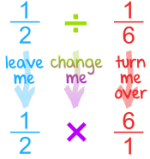
"leave me, change me, turn me over" 
 

How Many?

A question like 20 divided by 5 is asking "how many 5s in 20?" (=4)
So 1/2 divided by 1/6 is asking "how many 1/6s in 1/2"


1  ÷  1  is really asking:
26
How many  1  in  1  ?
62

Now look at the pizzas below ... how many "1/6th slices" fit into a "1/2 slice"?
How many1/6in3/6? Answer: 3

So now you can see why 1÷13
26

Another Example:

1÷1
84

Step 1. Turn the second fraction upside down (the reciprocal):
1 becomes 4
41

Step 2. Multiply the first fraction by that reciprocal:
1×4=1 × 4=4
818 × 18

Step 3. Simplify the fraction:
4=1
82

Fractions and Whole Numbers

What about division with fractions and whole numbers?
Make the whole number a fraction, by putting it over 1.
Example: 5 is also 5
1
Then continue as before.

Example:

2÷5
3
Make 5 into 5/1 :
2÷5
31

Step 1. Turn the second fraction upside down (the reciprocal):
5 becomes 1
15

Step 2. Multiply the first fraction by that reciprocal:
2×1=2 × 1=2
353 × 515

Step 3. Simplify the fraction:
The fraction is already as simple as it can be.
Answer =  2
15

Example:

3÷1
4
Make 3 into 3/1 :
3÷1
14

Step 1. Turn the second fraction upside down (the reciprocal):
1 becomes 4
41

Step 2. Multiply the first fraction by that reciprocal:
3×4=3 × 4=12
111 × 11

Step 3. Simplify the fraction:
12=12
1

And Remember ...

You can rewrite a question like "20 divided by 5" into "how many 5s in 20"
So you can also rewrite "3 divided by ¼" into "how many ¼s in 3" (=12)


Why Turn the Fraction Upside Down?

Because dividing is the opposite of multiplying!


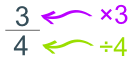
A fraction says to:  
  • multiply by the top number
  • divide by the bottom number
 
But for DIVISION we:
  • divide by the top number
  • multiply by the bottom number

Example: dividing by 5/2 is the same as multiplying by 2/5

So instead of dividing by a fraction, it is easier to turn that fraction upside down, then do a multiply. (Source:  https://www.mathsisfun.com/)

No comments:

Post a Comment